Pages

Monday, 14 September 2026

Have or Have got?


For starters, when it comes to the English language, it’s helpful to notice the difference between American and British English:

The verb “have” in American English


The verb “have got” in British English

As can be easily seen, the structures of all types of sentences – positive, negative and questions – are different. However, we should emphasize that in the Polish education system British English is more common, and the overseas structures are barely presented.


Ex. 1 


Wednesday, 22 November 2023

Black Friday is coming!


Have a look at the two pictures above and describe them.


  • What's happening?


  • What are the people doing?

  • How do they feel?

  • Why do you think there're so many people in the shops?


Sunday, 19 September 2021

The verb "have got"


Watch the video and answers the different questions that are presented to you during the video.

The video contains pictures from the movie "The Croods" and the main aim of the activity is to learn and practise how to describe people and their appearance.


Friday, 17 September 2021

The verb "to be"

Here you have mind map for the verb TO BE and the personal pronouns.

In these videos, you can watch a tutorial about the verb to be with some sentences to practice.


Monday, 9 March 2020

Wednesday, 4 March 2020

Introduce yourself


I truly believe that everything that we do and everyone that we meet is put in our path for a reason. There are no coincidences in life, there are no accidents; everyone has an opportunity to learn something from someone if you take the time to listen and pay attention. Trust your instincts and don’t be afraid to take risks. You can’t spend your day waiting for something to happen if you don’t take the initiative and start introducing yourself to people.


Watch the video from the minute 23:36 for a model text. 


Thursday, 13 February 2020

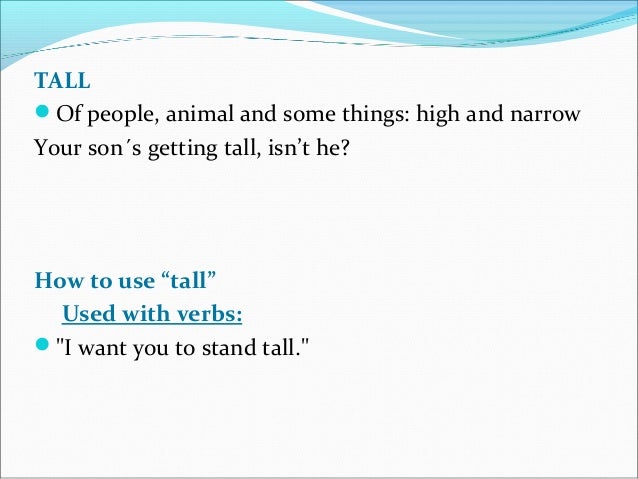
High or tall?


Expressions of quantity


Expressions of quantity tell us how many or how much of something there is.


We use a little and much only with non-countable nouns like money, snow, pollution etc.

We use a few and many only with countable nouns like people, cars, books etc.

Let’s take a look at some expressions of quantity that are used with both countable and non-countable nouns:

Countable and Non-countable Expressions of Quantity
Any
Countable: There aren’t any cookies left. (negative) / Are there any cookies left? (question)
Non-countable: There isn’t any water in the cup. (negative) / Is there any water in the cup? (question)

No
Countable: There are no dogs in the park.
Non-countable: There is no money in my wallet.
Some
Countable: Some children study here in the mornings. (affirmative)
Non-countable: There is some noise coming from that house. (affirmative)
More
Countable: There are more students in this school than in that other one.
Non-countable: There is more crime in poor countries than in rich countries.
A lot of / lots of
Countable: She has a lot of / lots of pets.
Non-countable: There’s a lot of / lots of traffic in my city.
Plenty of
Countable: There are plenty of cars on the street.
Non-countable: There is plenty of food in the fridge.
Most
Countable: She keeps most of her books in her backpack.
Non-countable: We spent the most time on the renovations.
All
Countable: Who ate all the oranges?
Non-countable: Jessica is the one with all the experience.
Enough
Countable: There aren’t enough cookies for everyone, we need to buy some more.
Non-countable: There is enough space for both of us.


Click on the exercises below to practice quantity expressions:


             First English
                                    Agenda Web
                                                                 Quiz